Welcome to the 16th issue of Wasl. This edition highlights Masaar’s latest publications on artificial intelligence, digital infrastructure, and internet connectivity in Egypt, alongside new analyses of key legal and judicial developments shaping the digital rights landscape in Egypt. It also features joint publications with the Egyptian Initiative for Personal Rights (EIPR), recent research from across the Arab region, and the latest episode of the CONNECT podcast.
Featured Publications
Amending the Cybercrime Law Is Not the Answer: A Legislative Position Paper
The Egyptian Parliament has begun considering new amendments to the Cybercrime Law, framed as a response to online extortion, gambling, and online games in the name of protecting children and young people.
This paper challenges the push for broader criminalization and harsher penalties, highlighting the limits of punitive approaches to digital and social challenges that cannot be addressed through criminal law alone. English | Arabic

A Critical Analysis of the Risks of AI Integration in the Criminal Justice System through Public Prosecution
The Public Prosecution announced a project in February to integrate AI-powered systems into the justice system. This paper offers a critical reading of this direction, one that does not reject technology itself, but instead interrogates the legal and institutional context in which it will be deployed. English | Arabic
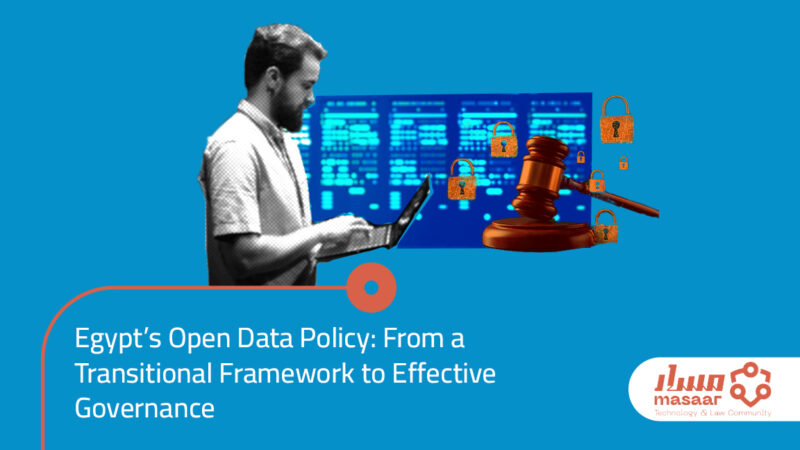
Egypt’s Open Data Policy: From a Transitional Framework to Effective Governance
Masaar has published a policy paper evaluating the rollout of Egypt’s Open Data Policy as a transitional framework preceding the forthcoming Data Governance Law. The paper concludes that the policy’s impact will remain limited unless it is reinforced by comprehensive legislative reform and independent enforcement mechanisms that secure the public’s right to information.
The paper is accompanied by three implementation annexes that set out open data publication and reuse standards, propose an initial list of entities required to share their data via the National Open Data Portal, and define the foundational principles for building the Authority on the foundations of independence, transparency, and privacy protection.
Governance of Emerging Technologies: Legal Challenges and Alternative Pathways
The paper explores the tension between rapid technological progress and slow legislation, asking whether laws should be enacted proactively, before technologies spread, or reactively, once their impacts are clear. Each approach carries trade-offs, demanding a balance between protecting rights and encouraging innovation. English | Arabic
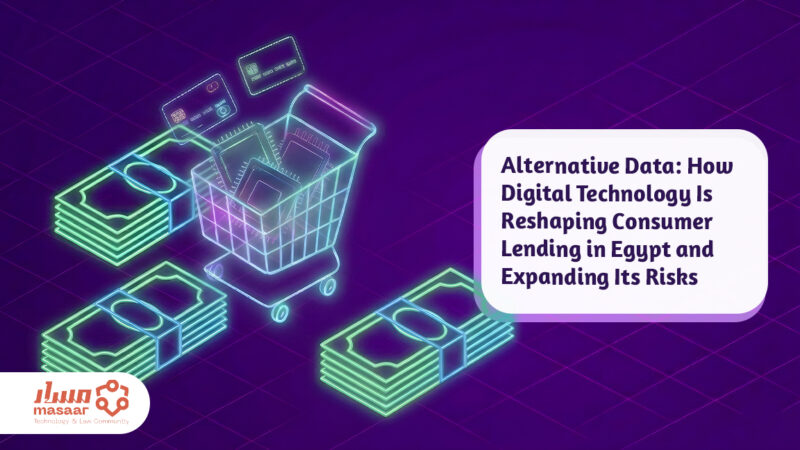
Alternative Data: How Digital Technology Is Reshaping Consumer Lending in Egypt and Expanding Its Risks
As “Buy Now, Pay Later” services rapidly expand, consumer lending is becoming deeply embedded in people’s everyday lives, driven by digital technologies that increasingly rely on “alternative data” to assess individuals and determine their access to finance.
Masaar’s paper explores how these technologies are reshaping the consumer lending landscape in Egypt by expanding access and raising important questions about data protection, algorithmic bias, and the gap between financial inclusion narratives and social justice realities. English | Arabic
Archives and the Digital Commons: How Is Knowledge Governed in the Digital Space?
This paper explores the relationship between two key concepts shaping the future of knowledge on the internet: archives and the digital commons. It examines how the digital commons movement has developed through initiatives such as Creative Commons and collaborative knowledge platforms like Wikipedia and highlights the importance of digital archiving in protecting the internet’s collective memory from loss or monopolization. English | Arabic
Joint Publications with EIPR
Executive Regulations of the Personal Data Protection Law: Assessing the Translation of General Rules into Enforceable Obligations
This legal commentary on the Executive Regulations of the Personal Data Protection Law examines two parallel dimensions. The first assesses the extent to which the Executive Regulations fulfill the legislative mandate delegated to them by the Law, including the regulation of licensing, permit, and accreditation frameworks, data security standards, and the rules governing cross-border data transfers.
The second analyzes the regulatory, rights-related, and compliance challenges arising from the Executive Regulations, as well as their likely practical implications for both data subjects and entities subject to the Law. English | Arabic
Without Trade-Offs: Towards Protecting Children Online While Respecting Their Rights
As debates over children’s online safety continue to intensify, Masaar and the Egyptian Initiative for Personal Rights have published a study that critically examines the direction of public policies in this area. The study warns against conflating protection with surveillance and against using children’s safety to justify expanding identity verification and monitoring measures without necessarily providing meaningful protection.
Adopting a human rights-based approach, the study argues that the primary source of risk lies not in children’s presence online, but in the design of digital environments and platforms, which often amplify risks rather than mitigate them. Arabic | English Soon
Digital Infrastructure and Connectivity in Egypt
As digital infrastructure becomes increasingly central to economic development, public services, and everyday life, understanding how it is governed, financed, and accessed is more important than ever. This collection from Masaar’s publications examines key dimensions of Egypt’s digital infrastructure, from submarine cables and cloud computing to internet pricing and the right to affordable, meaningful connectivity.
- From Global Data Corridor to Control Gateways: A Reading into Egypt’s Digital Infrastructure English | Arabic
- Cloud Computing in Egypt: An Analysis of Growth Trajectories and Their Impacts on Resources and Rights English | Arabic
- How Do Internet Pricing Policies in Egypt Undermine the Right to Access? English | Arabic
- The Right to Connectivity Under Price Pressure English | Arabic
Court Ruling Analysis
This collection examines a selection of court rulings addressing key issues related to digital rights, including the admissibility of digital forensic evidence, the legal limits of website blocking, and telecommunications companies’ responsibility for verifying users’ identities. These analyses highlight the emerging legal principles established by the courts and their broader legal and practical implications.
- New Judicial Trend: Criminal Court Overturns Conviction Due to Invalidity of Digital Forensic Evidence English | Arabic
- Court of Cassation Rules Against Expansive Use of Website Blocking Regulations English | Arabic
- Telecommunications Companies’ Responsibility for Identity Verification: Reading a Court Ruling Invalidating a SIM Card Contract Arabic
Guides and Manuals
This collection brings together practical resources designed to help lawyers and website owners navigate Egypt’s evolving legal and regulatory framework for digital technologies.
- Lawyers’ Guide to Interpreting Technical Expert Reports in Cybercrime Cases Arabic
- Guide to Website Licensing in Egypt: What Website Owners Need to Know Arabic | English
Technology and Equality
These publications examine how digital technologies shape experiences of equality and exclusion, exploring the ways in which online platforms, governance processes, and artificial intelligence can reinforce or challenge existing gender inequalities.
- Content Creation and Gender Dynamics: Who Shapes the Other? English | Arabic
- Internet Governance and Gender Justice: Representation Gaps and the Limits of the Multistakeholder Model English | Arabic
- Gender Bias in Artificial Intelligence Models: How Data Reproduces Discrimination Against Women English | Arabic
Legal Memoranda
These legal memoranda provide practical arguments and model appeals addressing key constitutional and legal issues affecting digital rights, supporting strategic litigation and legal advocacy in Egypt.
- Memorandum Challenging the Constitutionality of Website Blocking Provisions in the Press and Media Regulation Law Arabic
- Legal Memorandum Arguing the Unconstitutionality of Amendments to the Criminal Procedure Law on Recording Conversations in Private Premises (Articles 80 and 117) Arabic
- Model Appeal Memorandum Against a Decision Denying a Website License Issued by the Supreme Council for Media Regulation Arabic
- Substantive Defense Memorandum: Possessing and Using a Drone without a Permit Arabic
New on “CONNECT” Podcast (Arabic Audio)
- Episode (22) | Regulating Drone Use in Egypt: Licensing Requirements and Penalties
Find the podcast at Apple Podcasts | Spotify

From the Arab Region
SMEX | Technology was meant to serve people. Has AI changed that principle?
This essay from SMEX explores the role of artificial intelligence in Arab societies, arguing that AI should be evaluated by its ability to serve the public interest and improve people’s lives rather than by the speed of its adoption alone. It also calls for ethical and legal frameworks that ensure human oversight and accountability while clearly defining who benefits from these technologies and who bears responsibility for their potential harms. English | Arabic
7amleh | The Platformicide of Palestine (2021–2025)
7amleh has published research documenting patterns of censorship and suppression targeting Palestinian content across Meta’s platforms over a five-year period. The research analyzes 3,520 cases documented by the Palestinian Digital Rights Violations Observatory (7or) between 2021 and 2025. The findings suggest that Meta’s moderation of Palestinian content reflects recurring patterns in policy enforcement and content moderation practices rather than isolated or incidental errors. English | Arabic
Submit Your Proposals for Bread&Net 2026
Bread&Net returns to Beirut in 2026 under the theme “Realities Reimagined,” bringing together activists, technologists, researchers, and policymakers to collectively reimagine, experiment, and collaborate on building a more just, sovereign, and community-centered digital future across the WANA region.
Bread&Net 2026 will take place in Beirut from 14–16 October. Proposal submissions are open until 10 August.