
Introduction
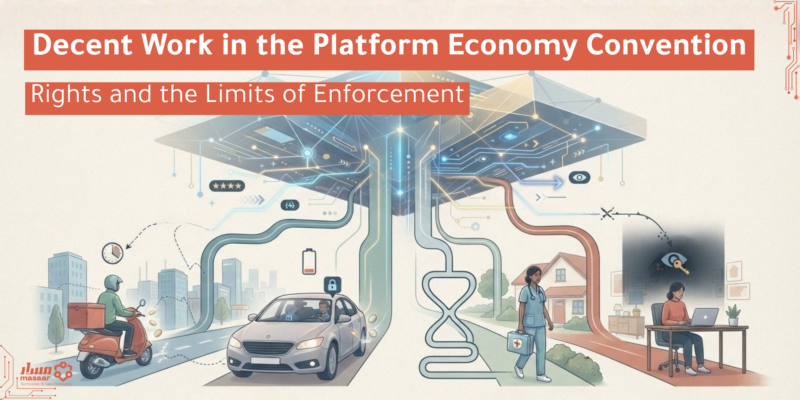
A platform worker’s relationship may begin with creating an account and accepting the platform’s terms of use, rather than with an employment contract specifying remuneration, working hours, and the parties’ responsibilities. However, the contractual form of the relationship does not eliminate the platform’s actual control over the work. The platform regulates access to work, monitors performance, and influences workers’ income and the continuation of the relationship. This control is often exercised through automated systems whose rules are unknown to the worker and whose effects the worker cannot verify due to a lack of access to the relevant records.
This creates a disparity between the reality of work and its legal classification, as the worker may be economically dependent on a platform that controls their opportunities, even while the terms of use describe them as an independent contractor or self-employed service provider. This classification has significant consequences for the rights available to workers and for how the costs of work are allocated. It affects the right to a minimum wage, reimbursement of work-related expenses, social protection, and collective organization. It also determines which party bears the risks of income disruption, injury, or loss of access to work.
The Convention Concerning Decent Work in the Platform Economy (No. 193) was adopted to address this problem by recognizing a person performing work through a platform as a digital platform worker, regardless of their classification of status in employment. The Convention also subjects aspects of remuneration, data, access to work, automated decisions, and account suspension to specific safeguards.
However, the Convention does not presume the existence of an employment relationship in every case, nor does it establish a general presumption in favor of the worker, nor does it automatically grant all rights accorded to employees. Instead, certain provisions of the Convention rely on the legal classification of the employment relationship when determining the scope of rights whose application entails costs borne by the employer or the social protection system.
This paper interprets the Convention as a basis for recognizing the platform worker, rather than as a comprehensive system of protection. Its significance lies in bringing platform workers within the scope of international labor law and recognizing that work may be managed through data, ratings, automated systems, and terms of use, without direct human supervision. At the same time, the Convention leaves it to national law to resolve issues that determine the actual impact of this recognition, such as proving the employment relationship, accessing platform data, calculating time and expenses, distributing responsibility between the platform and the intermediary, and enforcing rights against foreign platforms.
The paper examines the extent to which the Convention can translate recognition of platform workers into enforceable labor protections, as well as the legal and institutional conditions required to achieve this. The Egyptian context illustrates this challenge because platform work sits at the intersection of several legal frameworks. Some aspects may fall under the Labor Law; the Personal Data Protection Law governs data; certain activities are regulated by sector-specific legislation; and other legal frameworks govern social protection and collective organization.
This distribution of regulatory responsibilities may fragment disputes among different entities or authorities, each addressing a separate aspect, even though pay, ratings, suspension, data, and contractual intermediation operate within a single framework that determines the worker’s position in relation to the platform.
The paper relies on a textual and analytical reading of the Convention’s provisions in light of the Egyptian legal and institutional context. It does not present a field study on the number of platform workers, their income, or their working conditions, as these issues require separate research and direct sources. The analysis focuses on the scope of the Convention and the implications of employment classification, before turning to remuneration, social protection, automated systems, data, occupational safety, suspension, and cross-border work, and finally to the responsibilities of intermediaries and enforcement mechanisms.
From User to Worker: Redefining the Employment Relationship in the Platform Economy
A platform worker may not enter the relationship through a traditional employment contract and may not be legally treated as an employee. In some work models, the relationship begins with creating an account on an application that provides access to tasks, while the terms of use, rating systems, and task allocation systems establish the rules governing that access. Depending on how the platform operates and on the actual circumstances of the work, these tools and mechanisms may give the platform authority to direct and monitor the work and control access to work opportunities, even where the relationship is not contractually characterized as an employment relationship.
A worker’s income is not determined solely by the stated payment for each ride, order, or task. That payment reveals only part of the relationship, because actual income depends on how tasks are made available, the time the worker remains available to work without pay, and the costs and risks imposed by the platform. When the account itself becomes the sole condition for earning income, the risk of suspension or loss of access becomes a form of job loss, even if the relationship is not legally classified as an employment relationship.
The central question from a labor-rights perspective is therefore less about the label the platform gives the relationship and more about who controls access to work and who can cut off that access.
Article 1 of the Convention reflects an aspect of this shift by defining a digital platform as a legal person or, in accordance with national law, a natural person that uses automated decision‑making systems to organize or facilitate work performed by individuals in return for remuneration or payment, whether the work is performed online or at a specific geographical location.
Article 1 defines the digital platform worker as a person who is employed or engaged to work providing a service organized or facilitated by the platform, in return for remuneration or payment, regardless of their classification of status in employment. It also defines an intermediary as an entity that enables a platform worker to perform their work through a direct contractual relationship, or within a subcontracting chain.
Article 1 does not determine the legal status of the platform worker, nor does it make the performance of work through an application an automatic indication of an employment relationship. It merely specifies when the platform falls within the scope of the Convention, namely, when it uses automated decision‑making systems to organize or facilitate human work for remuneration or payment.
The significance of this becomes apparent when the analysis moves beyond the definition to the regulatory implications. Where a platform establishes the rules governing access to tasks and income, or manages the allocation of work and performance evaluation, the relationship can no longer be understood simply as one between a worker and a client, mediated by a neutral intermediary. However, Article 1 alone is insufficient to draw legal conclusions about the implications of this role. It defines the scope of the Convention and its parties, but does not set a criterion for distinguishing an employment relationship from other forms of engagement.
This is why Article 9 addresses the classification of status in employment, Articles 13 to 15 address automated systems and their impact on working conditions and access to work, and Article 17 addresses the suspension or deactivation of accounts and the termination of employment or engagement. Together, these provisions provide a basis for assessing the authority exercised by the digital labor platform and determining the protections or liabilities that may follow.
Scope and Limits of Protection under the Convention
The Convention’s preamble recognizes that the platform economy has created opportunities for income generation, enterprise development, and the formalization of certain forms of work. At the same time, it acknowledges existing decent work deficits and the cross-border nature of platform work, where the worker, platform, and client may be located in different countries.
The Convention also recognizes the role of digital labor platforms and of small, medium-sized, and micro-enterprises, as well as the need for an enabling environment for sustainable enterprises and fair competition. This language reveals the compromise underlying the text, which seeks, on the one hand, to protect workers and, on the other, to avoid disrupting the platform business model.
This balance is reflected in the scope of the Convention and the exceptions it permits. Article 2 establishes, as a general rule, that the Convention applies to all digital labor platforms and their workers, whether in the formal or informal economy, unless otherwise specified in its provisions. However, it allows states, after consultation, to exclude limited categories of platforms or workers if special problems of a substantial nature arise.
The Convention does not require states to eliminate these exceptions immediately or in all cases. Rather, it asks them, where practicable, to take measures aimed at gradually extending the scope of application, while indicating the categories excluded, the reasons for their exclusion, and the measures taken with respect to them in the reports submitted under paragraphs 4 and 5 of Article 2.
Article 3 refers to the fundamental principles and rights at work, including freedom of association and collective bargaining, non-discrimination, and the right to a safe and healthy working environment. This reference confirms that fundamental international labor standards cover platform workers. However, it does not specify mechanisms that enable geographically dispersed workers, often classified as self‑employed, to organize collectively, nor does it, in itself, grant them the right to access the data and evidence held by the platform.
The reference to the fundamental principles and rights at work provides an important normative foundation, but it does not, on its own, constitute a complete protection mechanism. It affirms that platform workers are entitled to freedom of association, collective bargaining, protection against discrimination, and occupational safety. However, it does not explain how geographically dispersed workers, whose access to work may be affected by ratings, automated allocation, and account suspension, can effectively exercise these rights in practice.
Turning these principles into enforceable protections requires collective representation capable of engaging with the platform, evidentiary rules that obligate the platform to disclose the data necessary to resolve disputes, and an enforcement authority capable of assessing algorithmically managed work as a potential employment relationship rather than merely as a digital service. In the absence of these elements, these principles may remain broad declarations that are difficult to translate into effective protection in practice.
How Classification Affects Platform Workers’ Rights
Classification operates in the Convention as a recurring textual constraint on the scope of protection. Article 1(b)(3) recognizes a digital platform worker regardless of their classification of status in employment, that is, regardless of whether they are considered under national law to be a worker in an employment relationship, a self-employed worker, an independent contractor, or to fall within another legal category. However, this recognition does not eliminate the legal effects of classification, because other provisions refer back to it when determining the nature of certain rights, the standard of comparison, or the conditions for their application.
This is evident, first, in the definition of remuneration or payment. Article 1(d) links the amount due to a digital platform worker to their classification of status in employment under national laws and regulations, collective agreements, or contractual obligations, and excludes from the definition of remuneration any compensation for expenses or other costs incurred by the worker in carrying out the work.
Article 10 follows a similar approach, not because it uses the term “classification” itself, but because it distinguishes between a general guarantee, under Article 10(1), that all digital platform workers receive the full amount of remuneration or payment due to them and on time, and narrower guarantees applicable to digital platform workers in an employment relationship: the minimum wage under Article 10(2)(a), and reimbursement of expenses or other costs incurred in performing the work under Article 10(2)(b).
As for workers who are not in an employment relationship, Article 10 does not directly grant them these guarantees. Instead, it requires the state, under Article 10(3), to consider extending the scope of certain measures to include them, particularly the measure concerning the minimum wage.
The effect of classification is also evident in Article 12, which does not establish uniform social protection for all platform workers, but requires that they benefit from social security on terms no less favorable than those applicable to other workers with the same classification. Article 23 adopts the same approach in implementing the Convention, requiring protection no less favorable than that enjoyed by other workers with the same classification of status in employment.
Article 15(1) addresses classification more narrowly. Where an automated system makes decisions, it guarantees workers, upon request and without unreasonable delay, the right to a written explanation of certain significant decisions and to a review of certain adverse decisions, taking into account their classification of status in employment.
Thus, classification remains present in specific areas: it determines the remuneration due, limits the scope of certain wage and expense guarantees, defines the category of workers with whom the platform worker is compared when assessing the level of social protection and other rights, and is also taken into account when applying certain rights to explanation and review relating to automated decisions.
Article 9 is therefore central. It requires states to ensure the correct classification of digital platform workers in respect of the existence or non-existence of an employment relationship, guided mainly by the facts relating to the performance of work, the remuneration or payment of the digital platform worker, among other elements, and considering the specificities of work via digital labor platforms. The importance of this article lies in the fact that it does not rely solely on the contract’s description to determine the nature of the relationship; rather, it bases classification on the actual facts of work performance. However, it does not establish a legal presumption of an employment relationship, nor does it expressly shift the burden of proof to the platform.
The practical gap becomes apparent when a dispute arises. Where evidence of control exists in the platform’s records, from task allocation and ratings to the reasons for reduced access to tasks or account suspension, the facts-based standard may be robust in principle but weak in practice. The worker is required to prove the nature of a relationship for which they often lack the underlying data, while the platform retains the records that reveal how work is made available, how performance is evaluated, and how opportunities to access income are affected.
Implementing the Convention in Egypt, therefore, requires an algorithmic subordination test that examines forms of control exercised through automated systems and goes beyond traditional criteria for administrative subordination. This test should examine who determines payment, commissions, and deductions; who allocates tasks; how refusal or ratings affect access to tasks and income; who holds performance data; who can suspend accounts or restrict access to work; and whether the worker bears the costs of work tools while being economically dependent on a single platform or on the platform economy as a whole.
This test is not complete without taking intermediaries and contracting chains into account. Article 1(c) of the Convention recognizes that an intermediary may enable a digital platform worker to perform work either through contractual relationships with the digital labor platform and the worker, or as part of a subcontracting chain between them. Accordingly, the worker’s relationship with the platform may not always take the form of direct engagement but may instead operate through a fleet owner, an operating company, a labor-supply agency, or a local intermediary.
The existence of an intermediary does not negate the question of control. If the platform remains, directly or indirectly, able to organize access to work, influence its conditions, or benefit from its arrangement through a contractual chain, the intermediary should not obscure the reality of the relationship that produces the work and distributes its income and risks.
That is why Article 24(3) requires that, where the use of intermediaries is permitted, states define the responsibilities of digital labor platforms and intermediaries and allocate those responsibilities in a manner that ensures compliance with the provisions of the Convention.
It is therefore not sufficient for a platform to disclaim responsibility on the ground that the worker has no direct contractual relationship with it. The contract alone does not reveal which party controls the working relationship. The intermediary may be the party that signs the contract or manages day-to-day communication with the worker, while the platform may, in many cases, retain control over the rules governing task allocation, remuneration, access to tasks, and account acceptance or suspension. In such cases, the intermediary is not a substitute for the platform’s responsibility, but rather a link within a broader contractual arrangement through which the work is organized.
Net Earnings and Unpaid Working Time
In platform work, it is not enough to consider the gross income that appears to the worker after each order or task. This figure alone does not reveal the necessary expenses the worker bears to perform the work, such as fuel, maintenance, phone and internet costs, equipment, or payment fees. Nor does it reveal the impact of commissions, deductions, and the waiting time between tasks.
The Convention supports this approach in two respects. Article 1(d) excludes reimbursement of expenses or other costs from the definition of remuneration, and Article 10(2)(b) expressly establishes reimbursement of expenses or other costs incurred, in accordance with national laws and practices, in performing the work as a guarantee for digital platform workers in an employment relationship.
Therefore, decent work on platforms should not be measured by apparent earnings before deducting expenses or by the number of tasks completed alone, but rather by what actually remains for the worker as income after accounting for the cost of work and the time they remain available to the platform.
Article 11 establishes a basis for holding platforms accountable for remuneration by requiring digital labor platforms to provide platform workers, promptly, with accurate, easily understandable information about their remuneration or payment and any deductions applied. The importance of this right lies in giving workers the minimum information necessary to challenge non-payment, deductions, or changes in remuneration. A worker cannot effectively contest their remuneration or payment without knowing what they were paid, what was deducted, and the basis on which those deductions were calculated.
However, the limits of Article 11 become apparent when considering how income is generated on platforms. A worker’s income may be affected by factors that do not all appear under the heading of “deductions,” such as variable pricing, task-allocation mechanisms, the worker’s ranking within the system, acceptance, rejection and cancellation rates, customer ratings, and incentive or penalty systems.
Some of these factors relate directly to remuneration, while others affect access to work itself. Information about remuneration and deductions is therefore insufficient, in the narrow sense, if the worker remains unable to understand the reasons for the decline in their income or the reduced opportunities to obtain higher-value tasks.
Article 11 should therefore be read together with Articles 13 and 15. Article 13 requires platforms to inform workers and their representatives, before they are employed or engaged, about the use of automated systems to monitor or evaluate work or to generate work-related decisions, as well as the extent to which these systems affect working conditions or access to work.
Article 15, under specific conditions, grants workers the right to a written explanation of significant decisions that adversely impact their working arrangements or access to work, and to a review of certain decisions that result in non-payment of an amount due, account suspension, deactivation, or termination of employment or engagement.
Thus, the right to information on remuneration alone does not translate into a full right to an explanation of income, but it becomes stronger when read together with the rights to information, explanation, and review relating to automated systems. Without this connection, it is difficult for a worker to prove that a decline in their income resulted from a breach in remuneration rules, discrimination, or an unannounced penalty. A worker who does not know why their remuneration has decreased, why deductions have increased, or why they are receiving fewer or lower-value tasks will often lack the evidence necessary to challenge the decision.
The implementation of the Convention should therefore seek to ensure that remuneration information is understandable and usable in disputes, rather than remaining merely a statement showing the final amount after the harm has occurred.
The issue of working time extends beyond the question of direct pay. The Convention does not establish an explicit standard for calculating waiting time, nor does it set a maximum limit on hours of connection to the application, nor does it detail a specific right to rest in platform work. In location-based work, the worker may be connected to the application, present in the area of demand, and ready to work, without compensation, until the ride or task begins.
In digital piecework, workers may also spend unpaid time searching for tasks, contacting support, or revising work that was rejected or unpaid. If this time is not counted, the payment received for each task may appear reasonable while masking a much lower effective hourly income.
A reading of Articles 12 and 23 also reveals the limits of the protection afforded to digital platform workers. Article 12 guarantees their access to social security on terms no less favorable than those applicable to other workers with the same classification of status in employment. Similarly, Article 23 requires states to provide them with a level of protection no less favorable than that afforded to other workers within the same legal category.
This means that a worker classified as self-employed is not compared with an employee, but with other self-employed workers. Accordingly, a national system may be considered compliant with the Convention if it provides platform workers classified as self-employed with the same level of protection afforded to other self-employed workers, even if that level of social protection is lower than that enjoyed by employees.
It is not enough to call for the inclusion of platform workers in the social insurance system in general terms, because social protection does not operate simply by adding a new category to the legal text. A platform worker’s income may vary from one week to the next, may come from more than one platform, and may be interrupted for periods the worker does not choose, resulting from declining demand, account deactivation, or changes to allocation rules. The system therefore needs a clear method for calculating insured income when the worker does not have a fixed monthly pay.
The second problem arises in determining who bears the cost of social insurance. If the worker remains classified as self-employed, the full contribution burden may, in practice, fall on them, including the portion that the employer would have otherwise borne in a traditional employment relationship. In that case, including the worker in the social insurance system amounts to formal recognition without real protection, because they are required to finance that protection from irregular income over which the platform controls access.
Work-related injuries also require an evidentiary standard that suits platform work. A worker may be injured while performing a task, on their way to a pickup point, or while connected to the application and available to accept a task. Without clearly determining when work begins and ends, the data that proves its relation to the task, proving an injury may become contingent on records that the worker does not possess, such as the order log, the geographic location, the time of connection to the application, and assignment or cancellation messages.
Therefore, any serious regulation of social insurance must specify how irregular income is calculated, how contributions are distributed among the worker, the platform, and the intermediary, where one exists, how work-related injury is proven using accessible data, and how periods of intermittent work across more than one platform are aggregated. Without these rules, a platform worker may be formally recognized, but remain outside an effective and enforceable social protection system in cases of illness, injury, or loss of income.
Occupational Safety and Health, Violence, and Third-Party Risks
Articles 4 and 5 make occupational safety and health an integral part of the regulation of platform work. Article 4 requires states to take appropriate measures to prevent accidents, occupational diseases, and other harm to the health of digital platform workers that arises out of, is connected with, or occurs in the course of their work.
When taking such measures, states must take into account the respective roles and responsibilities of public authorities, digital labor platforms, platform workers, and other relevant actors, including the complementary nature of these responsibilities, the classification of status in employment, and the need to assess occupational risks and adopt appropriate preventive and protective measures.
Article 5 adds a more direct right for the worker. It requires the state to ensure that platform workers have the right to refrain from continuing to work whenever they have reasonable grounds to believe that performing their work poses an imminent and serious danger to their lives or health, without suffering undue consequences, and that they shall inform the digital labor platform without delay.
The Convention recognizes that workers may need to stop working when faced with a direct and serious risk. The importance of this protection is evident in sectors such as delivery and transport. The risk is not limited to road accidents; it may also arise from time pressure within the application, incentive systems that encourage speed, working in unsafe areas or at unsafe times, or workers’ fear that refusing a dangerous task will reduce the number of tasks they receive or lower their ranking on the platform. In such cases, the penalty is not necessarily a written decision or explicit account suspension; it may instead appear as a gradual reduction in access to work opportunities.
This is why Articles 4 and 5 reveal a gap that the Convention does not fully address. It grants the worker the right to refuse dangerous work, but it does not establish an explicit rule shifting the burden of proof to the platform if the worker’s opportunities to obtain work decline after exercising this right.
Moreover, the connection between the right to safety, the right to an explanation of certain automated decisions under Article 15, and the prohibition of account suspension or termination on discriminatory or otherwise unlawful grounds under Article 17, remains contingent on the evidentiary and enforcement rules established by national law. Without such rules, the right to safety may remain recognized in the text but be effectively undermined through an opaque algorithmic sanction.
By contrast, Article 6 broadens the scope of protection by requiring states to provide all digital platform workers with effective protection against violence and harassment in the realm of work, including violence and harassment committed online or involving third parties, such as clients and customers.
The importance of this article lies in the fact that it involves the client in the risk analysis, not merely as a recipient of the service. In platform work, a client may be the source of violence or harassment and may also affect a worker’s rating, lodge a complaint against them, or influence their continued access to work. This issue is more sensitive in domestic services and care work, where the workplace is the client’s home, and it is difficult to document what happens there. It also arises in the transport and delivery sectors during handover or transit, and in digital work, where abuse or extortion may occur via communication channels.
It is therefore not enough to provide an in-app complaints channel if the client’s rating, on its own or to a significant extent, can affect the worker’s income or the continuation of their account. Effective protection requires a mechanism that prevents the worker from being penalized for filing a complaint and enables them to prove the incident without remaining simultaneously subject to the authority of both the client and the platform.
The gender dimension is particularly evident in this context. Article 25 addresses normative language by stating that the use of the generic masculine form does not exclude women. However, it does not provide substantive measures addressing gender-based risks in sectors such as domestic and care work. If this type of work remains outside the scope of national labor law protection despite being managed through a digital platform, the gap will not be merely sectoral; it will rather become a gender gap in the application of the protections established by the Convention.
Skills Development and the Regulation of Platform Work
Article 7 differs in nature from other articles on classification, remuneration, and automated systems. However, it raises an important question when read in the Egyptian context. It does not establish a detailed right to training, nor does it specify a particular career path. Rather, it calls on the state, within the framework of its national policies and in accordance with its circumstances, to take measures to promote decent work opportunities and to encourage the development of skills and career paths in the platform economy.
This wording is broad and programmatic and may be used within policies that view digital work as a rapid means of accessing the labor market or as an alternative to traditional jobs. However, the value of skills in platform work is not measured merely by the availability of training or the acquisition of technical experience, but by the ability of those skills to improve the worker’s position within the employment relationship and protect them from rapid replacement, irregular income, and piecework.
In remote digital work and data work, a worker may acquire technical, linguistic, or operational experience, but they remain subject to non-negotiable terms of use, fluctuating ratings, transfer fees, and cross-border competition. The problem therefore does not always lie in a lack of skills. The skills acquired may not provide a path to advancement or stability as long as the worker remains easily replaceable within a broad market driven by cost reduction.
Accordingly, Article 7 should not become a pretext for expanding precarious work in the name of training or employment. Skills development becomes part of decent work only when it is accompanied by fair remuneration, access to performance data, avenues for challenging adverse decisions, and protection against arbitrary exclusion or unexplained declines in access to work.
Article 8 requires states to take appropriate measures to facilitate the formalization of work carried out through digital labor platforms, including the registration of self-employed workers.
This path may serve as an entry point to protection if it is linked to social insurance, proof of income, regulation of the relationship between the worker and the platform, and facilitated access to complaint and redress mechanisms. However, it may conversely become merely an administrative registration of the worker in state records, without a corresponding clear obligation on the platform to bear its share of the cost of the work or to disclose the data necessary to prove rights.
Therefore, formalization should be treated as a means of achieving protection, not as an end in itself. Registration should not precede or replace protection. When a platform worker is registered with the state, this should be accompanied by rules guaranteeing their access to data on income, tasks, and deductions, defining the obligations of the platform or the intermediary where there are indicators of control or economic dependence, and providing them with an effective path for complaint in case of account suspension, non-payment of dues, or a decline in access to work.
Where these safeguards are absent, formalization may result in workers being registered in government records without affording them enforceable labor and social protection.
Algorithmic Management of Work and Access to Data
Articles 13, 14, and 15 constitute the most prominent provisions in the Convention relating to the management of work through automated systems. They require platforms to inform workers and their representatives about the use of these systems to monitor, evaluate, or make decisions related to work, and about the extent of their impact on working conditions or access to work. They also grant the worker, under specific conditions, the right to obtain a written explanation of certain decisions that adversely affect them, and to a review of certain decisions relating to non-payment of dues, account suspension, deactivation, or termination of employment, with an appropriate level of human oversight.
These articles recognize that work may be managed through automated systems, but they do not address all of the implications of such management. Informing workers that a system is being used does not constitute full disclosure of how it operates. Moreover, this explanation is not provided automatically but rather upon request submitted by the worker, even though they may not know that an automated decision has been made concerning them. The right to review also does not cover all decisions; it is limited to specified decisions and to cases where the relevant authority considers a review required.
Moreover, the phrase “responsible use” does not specify a measurable standard, and the “appropriate human oversight” may turn into a support employee reviewing the outcome within the same system, without any real authority to reverse a decision or provide redress to the worker. Algorithmic transparency should therefore be treated as an enforceable labor right, rather than merely as a notification to workers of the existence of an automated system.
Article 16 also addresses the protection of personal data and privacy. However, it should not be understood as a standalone privacy right detached from the employment context. A platform worker’s data constitute evidence of their relationship with the platform and can be grouped into three categories: income and working-time data; access and rating data; and dispute and safety data. Without access to these data, a worker cannot prove remuneration or any claims of discrimination, termination, or retaliation.
To make data protection rules an effective tool for protecting platform workers in Egypt, the application of the Personal Data Protection Law No. 151 of 2020 should not be limited to informing workers about the data the platform processes. Workers should be guaranteed access to their data, the right to obtain a usable copy and correct inaccurate data, and protection against the deletion of data relating to an ongoing dispute until grievance or litigation proceedings have concluded. These individual rights should also be distinguished from the authority of an inspection or grievance body, or a court, to require the platform to provide the records necessary to prove claims concerning remuneration, ratings, suspension, or discrimination.
Paragraph 4 of Article 24 requires states to protect platforms’ commercially sensitive information when implementing the Convention. However, this protection does not confer on platforms an absolute right to withhold information regarding pricing, ratings, task allocation, or account suspension, as workers’ rights to remuneration, explanation, review, and redress remain protected under other provisions of the Convention.
The Convention does not, however, provide a detailed standard for balancing the protection of commercially sensitive information against the worker’s right to prove their claim. National law should therefore provide that the protection of trade secrets does not prevent necessary and proportionate disclosure to the worker or the competent authority for the purpose of examining the dispute and establishing the right, while maintaining confidentiality measures that limit disclosure to what is necessary.
Suspension, Terms of Use, and Cross-Border Work
Article 17 prohibits the suspension or deactivation of a digital platform worker’s account, or the termination of their engagement or employment, where the decision is based on discriminatory or unlawful grounds. However, this protection does not amount to a general prohibition of all arbitrary or unjustified suspension. It does not, in itself, require the platform to provide prior notice, give detailed reasons, suspend the effect of the decision pending review, or compensate the worker where the decision is found to be unlawful.
Article 18 grants platform workers the right to receive, promptly, verifiable and easily understandable information about the terms and conditions of their engagement or employment. These terms should not be treated as a neutral contractual document. On digital labor platforms, terms of use serve as the governing rules for pricing, ratings, support, suspension, data processing, and access to work. It is therefore not enough for the terms to be available or written in clear language. They must also be usable in disputes and read together with the rights to explanation and review in cases involving automated decisions, as well as the redress mechanisms that the Convention requires states to make available.
Article 19 provides that the terms and conditions of employment or engagement of digital platform workers should preferably be governed by the laws and regulations of the country where the work is performed, unless national laws and regulations, international instruments, or multilateral or bilateral agreements provide otherwise, taking into account the contractual arrangements. This formulation does not create an absolute rule on the applicable law. Its flexibility may leave uncertainty in cross-border relationships, particularly where terms of use designate foreign law or where the parties to the relationship are located in different jurisdictions.
In freelance and data work, a worker in Egypt may perform tasks through a platform registered in another country for a client in a third country, while payments are processed through a financial intermediary. Paragraph 2 of Article 24 allows the Convention’s provisions to be applied to platform workers who work within a state’s territory and to platforms and intermediaries that carry out activities there. However, the Convention does not specify the criteria for determining whether a foreign platform is carrying out an activity within a state’s territory, nor does it alone address the difficulties of enforcement when the platform has no local presence, assets, or intermediary that can be compelled to implement decisions.
Article 20 adds a dimension that should not be overlooked in the Egyptian context. It requires the state to prevent abuse of migrant and refugee workers and provide them with adequate protection while they are employed or engaged and while performing work through digital labor platforms. The value of this protection lies not merely in including them in a more vulnerable category, but also in the design of complaint and redress mechanisms.
A worker who fears that filing a complaint may expose their legal status or increase their social or economic vulnerability may, in practice, be unable to challenge non-payment of remuneration, account deactivation, or violence perpetrated by a client, even where they have a theoretical right to protection. Article 20 should therefore be read together with Article 21 to ensure that protection goes beyond prohibiting abuse and includes a safe and effective avenue for migrants and refugees to file complaints and access redress without increasing their exposure to harm.
Enforcement and Allocation of Responsibility between Platforms and Intermediaries
Articles 21 and 22 of the Convention move from the recognition of rights to the question of their enforcement. States are not merely required to establish general protection for digital platform workers, but also to ensure that digital platform workers and digital labor platforms have access to safe, fair, and effective mechanisms for dispute resolution and redress, and to establish mechanisms to ensure compliance with and enforcement of relevant national laws and regulations and collective agreements.
The Convention does not specify the form of these mechanisms, their timeframes, or their authority to request records or halt harm. These elements therefore become critical to national implementation. Without short time limits for resolving disputes affecting workers’ income, authority to require pricing, rating, deactivation, and task-allocation data, and the power to halt harmful effects or order effective compensation, a redress mechanism may become a channel for filing complaints without changing the worker’s position within the relationship.
The institutional problem becomes apparent in the Egyptian context because the platform work relationship can be fragmented across multiple legal frameworks. The labor or inspection authority may view it as a dispute over the existence of a traditional employment relationship; the data protection authority may treat it as a privacy matter; the judiciary may read it through the lens of terms of use or contractual obligations; while the platform presents it as a dispute over a digital service.
These fragmented approaches are insufficient where income, ratings, access to work, deactivation, and data processing form part of a single relationship. Workers need an authority or grievance mechanism capable of addressing these elements together in a single case, with clear jurisdiction and legal authority to require the platform or intermediary to provide the records necessary to understand and resolve the dispute.
Intermediaries provide another test of whether enforcement mechanisms can capture the relationship as a whole. The Convention does not assume that a digital platform worker always deals directly with the platform. It defines an intermediary as a person who enables a digital platform worker to perform work through a contractual relationship with the platform and the worker, or as part of a subcontracting chain. It also requires states in which the use of intermediaries is permitted to define and allocate the responsibilities of digital labor platforms and intermediaries in a manner that ensures compliance with the provisions of the Convention.
In these cases, it is not sufficient for the law to define the intermediary or acknowledge its existence. A problem arises when the contractual chain becomes a means of fragmenting responsibility, such that the worker faces a local party of limited capacity while the rules governing pricing, ratings, suspension, and access to work remain in the hands of the platform or within a broader contractual structure.
Furthermore, the platform’s responsibility is not limited to the technical system; it also extends to how costs are distributed within the business model. The intermediary, the terms of use, and automated systems are not separate tools; they are elements of a single contractual and organizational structure that may shift the risks of flexibility onto the worker while the more powerful party retains the data and the ability to regulate access to work.
Therefore, enforcement can only be effective if it treats the relationship as a single economic and legal structure, rather than as a set of separate disputes concerning labor, privacy, contracts, and digital services.
The Egyptian Context and Requirements for Implementing the Convention
The Egyptian context provides a useful test of whether the Convention can deliver effective protection in practice. The precariousness of large sectors of the workforce, income instability, limited capacity for collective organization, and the fragmentation of enforcement agencies do more than add local challenges to an international framework. They reveal whether international recognition of the platform worker can be translated into tools that reshape the allocation of evidentiary burdens and costs. Recognition may result in formal compliance if institutions lack the capacity to enforce transparency, correct classification, and access to data held by the platform.
Labor Law No. 14 of 2025 regulates several forms of modern work, including remote and flexible work. However, this does not mean that it has created a special system for platform work or resolved the legal status of the platform workers. Regulating the workplace or the flexibility of working hours does not necessarily address the platform’s authority to assign tasks, evaluate performance, or suspend accounts, nor does it determine the implications of workers’ economic dependence on the platform or their right to access their work-related data. Therefore, the classification of the relationship depends on whether the law can recognize forms of algorithmic control, rather than on subjecting them solely to traditional criteria of administrative subordination.
The forms of such control vary across sectors in Egypt. In field-based work, such as transport and delivery, control is linked to task allocation, waiting time, the costs of work-related tools, ratings, and account suspension. In remote digital work, the key issues include terms of use, performance data, cross-border payments, and the applicable law.
Law No. 87 of 2018 regulating Land Transport Services for Passengers Using Information Technology in Egypt provides an example of sector-specific regulation that specifies licensing and operational requirements for passenger transport services delivered through applications, without determining drivers’ employment status or their rights vis-à-vis the platform. Regulation of the activity, therefore, remains separate from regulation of the employment relationship that may arise from it.
Moreover, the Personal Data Protection Law does not protect the platform worker unless the rights to review, rectification, and data protection can be converted into evidentiary tools in disputes over remuneration, evaluation, suspension, and discrimination. Meanwhile, social insurance, trade union, and competition laws remain critical to the allocation of costs and bargaining power, as they determine who bears social insurance contributions, whether workers classified as self-employed can organize and bargain collectively, and whether such collective bargaining will be protected as a labor right or instead characterized as anti-competitive coordination.
Restrictions on trade union activity also raise questions about the effectiveness of the consultation required by the Convention with the most representative organizations. The problem is not limited to the mere existence of formal consultations; it also extends to the ability of these consultations to reach workers who are dispersed, institutionally invisible, and who may be classified outside the traditional employment relationship. The International Trade Union Confederation’s Global Rights Index ranked Egypt among the ten worst countries for workers in 2025, underscoring the need to treat worker representation as a prerequisite for enforcement rather than a subsequent measure.
The state’s desire to expand digital work as a source of income, an employment opportunity, and a market for cross-border services may lead it to focus on registering and administratively regulating such work without requiring platforms to bear their share of the cost of protection. In such a case, weak enforcement may be attributable not solely to administrative shortcomings but also to policies that preserve flexibility, low costs, and ease of administrative registration without providing equivalent protection for workers.
If Egypt ratifies the Convention, ratification should not be regarded as the end of the implementation process. Effective implementation requires representation of those who perform the work and the involvement of bodies capable of interpreting its technical and legal structure, rather than relying solely on consultation with parties that do not reach dispersed workers. The importance of this representation stems from the fact that the implementation of the Convention affects how risks and costs are distributed among the platform, the worker, the state, and the client.
Implementation first requires reforming the legal framework for classification. Article 9 of the Convention requires the state to ensure correct classification based mainly on the facts relating to the performance of work, remuneration or payment, and other relevant elements, while taking into account the specific characteristics of platform work.
However, Article 9 does not establish a presumption of an employment relationship, nor does it expressly shift the burden of proof to the platform. National legislation therefore needs a rebuttable presumption where indicators of algorithmic control or economic dependence are present, together with a rule shifting the burden of proof to the platform when evidence of such control is contained in its records. Without such safeguards, classification will remain a contractual label chosen by, or benefiting, the more powerful party.
At the same time, implementation requires that data access be made an enforceable labor right. The competent labor authority or grievance body must have the authority to request a minimum set of records, including income, hours worked, access to tasks, ratings, deductions, and suspension decisions. These records should be provided within a short timeframe in the event of a dispute, and withholding them or providing incomplete records must have legal consequences in favor of the worker. Trade secret protection should not extend to withholding evidence necessary to prove remuneration, discrimination, account suspension or deactivation, or retaliatory measures against the worker.
Remuneration protection cannot be effective unless it shifts from gross pay to net income. Article 10 guarantees the payment of remuneration or payment due. It provides broader guarantees for platform workers in an employment relationship. Still, it does not, in itself, establish a standard for calculating waiting time, expenses, or deductions when determining the actual income.
Therefore, the law should link the minimum wage to the net income for each hour the worker is actually subject to the platform’s regulations, so that necessary expenses, waiting time, deductions, and payment fees are taken into account when assessing remuneration rather than excluded from the calculation. Without this standard, the cost of work may be shifted onto the worker while maintaining formal wage compliance.
Social protection, in turn, requires a system that accommodates fluctuations and interruptions in income. Article 12 guarantees platform workers’ access to social security on terms no less favorable than those applicable to other workers with the same classification of status in employment, but it does not address the gaps in protection that may be associated with that classification.
The law should therefore establish a flexible mechanism for contributing to social protection systems without requiring self-employed workers to bear the share usually borne by the employer. This protection should also cover injuries occurring while performing a task or traveling to carry it out, and allow for the aggregation of periods of work and income across multiple platforms, including periods of interruption.
Platform work disputes require a swift and specialized grievance mechanism that considers, within defined time limits, complaints concerning non-payment of amounts due, account suspension or deactivation, discrimination, and retaliatory measures implemented through automated systems. This mechanism should have the authority to temporarily suspend a decision where it threatens the worker’s source of income, require the platform or intermediary to provide the necessary records, and shift the burden of proof where there are serious indications of retaliation or unjustified deactivation.
Grievance procedures should also be safe and accessible to migrant and refugee workers. Their jurisdiction should extend to local intermediaries and to foreign platforms where there are indications that the platform is carrying out activities in Egypt, based on criteria established by law. The law should also require such platforms to appoint a legal representative or establish a local registration, or provide for enforceable liability on the part of the local intermediary, to ensure that decisions issued against the platform can be effectively enforced.
Implementation cannot be complete without protecting collective organization. Therefore, sectoral forms of representation for platform workers, including those classified as self-employed, should be recognized and empowered to bargain collectively over remuneration, data, account suspension, and safety. Such protection loses its meaning if a platform can reduce task allocations or suspend an account because of such organization, or if competition law is used against collective bargaining by workers who lack real market power compared to a platform that controls the data and access to work.
Gender and protection gaps reveal another limit of legal recognition. If domestic and care work performed through platforms remains outside the scope of national labor law’s protection, or if violence and harassment on a client’s premises are treated as individual incidents rather than as risks associated with the organization of work, the protection established by the Convention will have an unequal impact.
Specific rules should therefore be established to address violence and harassment on clients’ premises, together with a complaints mechanism that does not allow ratings or income to be used to penalize complainants. The same protection should extend to migrant and refugee workers, so that filing a complaint does not increase their exposure to harm.
Finally, the fragmentation of liability through intermediaries must be prohibited. The Convention does not expressly impose joint and several liability on platforms and intermediaries, but it requires states, where the use of intermediaries is permitted, to define and allocate their respective responsibilities in a manner that ensures compliance with the Convention. National law should therefore establish joint and several liability, or an equivalent form of shared liability, for remuneration, social insurance, occupational safety, data protection, and unlawful deactivation.
Furthermore, the worker must be exempted from the burden of identifying the responsible party within a contractual chain over which they have no control. This responsibility should be backed by clear sanctions and jurisdictional and enforcement rules that apply to foreign platforms organizing work performed by workers in Egypt.
Conclusion
The Decent Work in the Platform Economy Convention, 2026 (No. 193), is not sufficient to lift platform workers out of precarity merely by recognizing them. Its significance instead lies in bringing platform workers within the scope of international labor law, while leaving effective protection dependent on who bears the costs of the work organized by the platform and who holds the evidence of how that work is organized.
At this point, the Convention moves from recognition to practical disputes over work-related expenses, access to work data, the lawfulness of deactivation, the financing of social protection, and the responsibility of parties whose roles are mediated through intermediaries, terms of use, or automated systems.
The Convention provides a set of tools that national law can build on. It requires proper classification and provides a basis for accountability regarding remuneration and deductions, while bringing automated systems, data, and account suspension within the scope of labor protection. However, it does not itself resolve the presumption of an employment relationship, the burden of proof, the calculation of waiting time and expenses, the authority to request records, the limits of trade secret protection where it conflicts with a worker’s right to evidence, or the form of liability applicable to platforms and intermediaries where the working relationship is distributed among multiple parties.
Therefore, the impact of the Convention depends on the ability of national law to translate recognition of platform workers into rules requiring the entity that organizes the work and benefits from it to bear its share of the costs and to provide the data and evidence necessary to enforce these rights.
In Egypt, the challenge does not lie in adding a new category to the law or incorporating digital work into labor policies. It lies in the regulation’s ability to treat the platform as an entity that controls the conditions of access to work, not as an application that connects workers with clients.
If classification continues to be governed by contractual descriptions, if pricing, rating, and suspension decisions remain in the hands of the platform, and if income continues to be measured by the gross pay rather than what remains after deducting expenses and unpaid time, then legal recognition alone will not improve the worker’s position within the relationship or enable them to establish their rights.
Effective implementation begins with building mechanisms capable of understanding the platform relationship as a whole, not with ratification alone. This requires an enforcement authority capable of requesting records and analyzing the impact of automated systems on pay and access to work; classification rules that capture algorithmic control and economic dependence; social protection suited to irregular income; collective representation that does not exclude workers classified as self-employed; and liability rules that prevent the fragmentation of obligations between the platform and the intermediary. Without these elements, formalization may amount to merely registering workers in state registries rather than providing them with enforceable labor protections.
The effect of the Convention in Egypt will depend on what happens at this level. It may become a tool for redistributing the burden of proof, costs, and responsibility within the platform economy, or remain a new legal label for workers whose income, protection, and right to challenge decisions remain dependent on decisions they cannot scrutinize and for which they cannot access the evidence needed to challenge them.