Introduction
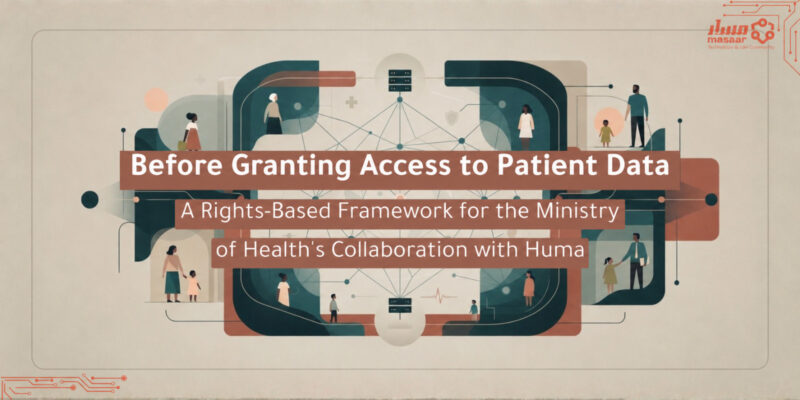
On 16 November 2026, Egypt’s Ministry of Health and Population announced that it was exploring collaboration with the UK-based company Huma to advance the use of artificial intelligence and digital healthcare. The official statement referred to the use of databases made available through the 100 Million Healthy Lives initiatives to improve diagnosis, disease prediction, early cancer detection, and care for children and newborns. It also noted that the Minister had directed that operational coordination with the company be accelerated.
However, the statement did not announce the signing of an agreement, identify the systems to be used, or confirm that any patient records had been made available. This paper, therefore, examines risks that must be addressed before implementation, without attributing violations that have not been established.
The significance of these discussions lies in the nature of the information involved. Citizens provided health data to public institutions to obtain screening, follow-up care, or treatment. If this information becomes available for use in other processes operated by a commercial company, the issue extends beyond the choice of a technological solution to determining: who has the authority to decide how this information is used, who can access it, and how the rights of the individuals concerned are protected.
This includes arrangements with varying implications, ranging from purchasing a tool that operates within the Ministry without granting the company independent access to patients’ records, to making individuals’ data available or using it to test or develop models.
Improving healthcare remains a legitimate objective, and digital tools may enable faster disease detection and more efficient service management. However, these potential benefits do not deny the need to establish that data processing is lawful, necessary, and proportionate to the healthcare purpose.
This paper calls for disclosure of the legal and technical framework of the cooperation and for refraining from making identifiable patient records available or repurposing them for use before the appropriate safeguards are in place. It also calls for independent safety assessments of any system that may influence medical decisions before deployment. At the same time, the state remains responsible for ensuring these safeguards are in place, whether the data is transferred outside Egypt or stored on government servers.
A Private Company within Public Healthcare Infrastructure
Huma is a UK-based private company formerly known as Medopad. It provides platforms for remote patient monitoring, communication with medical teams, and the development of digital healthcare services. Its legal status is confirmed by the UK Companies Register.
The company offers products that combine software, clinical services, and digital analytics, and is not merely a party that produces a single diagnostic model. Accordingly, cooperation with Huma could involve operating a digital system connected to the Ministry of Health’s patient databases, which would require regular updates and ongoing technical support. Some of the system’s functions may also rely on services provided by other technology companies.
Huma’s privacy policy clarifies that when the company provides services to a hospital or healthcare institution, that institution is responsible for determining the purposes for which patient data is used, while Huma processes the data technically in accordance with the institution’s instructions. In the proposed cooperation with Egypt’s Ministry of Health, however, it remains unclear whether responsibilities will be allocated in the same way or whether the company will be granted additional authority to use the data.
The policy also identifies research and development as potential purposes for data use. It allows the sharing of de-identified or aggregated information for research, subject to arrangements and conditions that vary by service.
The International Data Transfer Disclosure identifies two cloud service providers and sub-processors involved in some of the company’s products, and outlines technical and contractual safeguards that the company says it implements. The same privacy policy states that the company does not sell personal information and provides for measures for data security and access control.
These commitments are worth noting, while distinguishing between the company’s general public statements and obligations set out in a specific contract that can be reviewed and enforced. The available documents do not disclose the terms of any project in Egypt, nor do they establish that the databases of the 100 Million Healthy Lives initiatives will be made available to Huma or its suppliers.
Accordingly, the nature and functions of the platform or digital service covered by the collaboration between Egypt’s Ministry of Health and Huma must therefore be disclosed. The disclosure must also specify each party’s legal responsibility for processing patient data, where the data will actually be processed, and which entities will have remote access to it. It must also clarify whether the data or any insights derived from it may be used for purposes beyond providing healthcare services.
Hosting the platform in Egypt does not necessarily mean that access to patient data will be restricted to entities based in the country. Huma’s technical support staff or contractors, for example, may be able to access the system remotely from abroad.
Conversely, hosting data outside Egypt does not, in itself, establish a legal violation; this depends on whether the applicable legal requirements governing data processing and transfers are met. This distinction is relevant to the references in official statements to “localizing technology”. The Ministry of Health must therefore clarify whether this refers to hosting the platform on servers in Egypt, or to transferring technical knowledge and building local capacity so that the Ministry can operate, assess, and manage the system without continued reliance on the company.
No Open-Ended Authorization to Repurpose Data
The 100 Million Healthy Lives initiatives comprise programs that differ in their purposes and the information they include. The original initiative began with screening for hepatitis C and non-communicable diseases, while subsequent programs expanded to include women’s health, cancer, chronic diseases, maternal and fetal health, and newborn screening.
However, the records generated by these programs cannot be treated as a single database serving a uniform purpose. Collecting measurements for early detection, recording medical histories to monitor treatment, and gathering the results of a child’s genetic screening are all distinct activities. They differ in the sensitivity of the information involved, the purposes for which it is processed, and the data subjects’ legitimate expectations regarding its use.
Articles 18 and 57 of the Egyptian Constitution guarantee the rights to health and privacy. Protecting these rights requires ensuring that digitizing healthcare services does not expand access to patient records without a clear need. From the perspective of the right to health, the project’s quality should be assessed by its ability to protect patient confidentiality, provide safe care, and distribute the benefits of its services equitably, as well as by the speed at which it processes information.
Egypt’s Personal Data Protection Law No. 151 of 2020 classifies information relating to physical, mental, and genetic health as sensitive personal data, and considers children’s data as sensitive in all cases. Articles 2 and 3 require that, in cases falling within the scope of the law, data be collected and processed with explicit consent or under circumstances authorized by law.
They also require that the purposes of data collection be lawful, specific, and declared, and that processing be proportionate to those purposes. Article 12 imposes stricter requirements on the handling of sensitive personal data, including licensing and explicit written consent, except in cases authorized by law, and sets out specific safeguards for children’s data.
However, whether to apply these provisions to the project cannot be determined in the abstract. Article 3 of the Personal Data Protection Law exempts data processed for the purpose of producing official statistics or in application of a legal text. This exemption does not extend to all state data merely because a government body holds it, nor does it automatically cease to apply when a company is assigned a technical task.
Assessing the extent to which the exemption applies requires identifying the legal provision the Ministry of Health relies on to collect and process each category of data. That provision must then be reviewed to determine whether it permits the new purpose and the involvement of a private contractor.
The assessment must also establish who determines the purposes and means of processing. This requires distinguishing between the entity that sets the purpose, a processor acting on that entity’s instructions, and a company that may seek to use the resulting data for a separate purpose of its own.
The Executive Regulations of the Personal Data Protection Law, issued under Decree No. 816 of 2025, make this distinction especially important. Article 2 treats an individual’s provision of personal data to obtain a lawful service as consent to the processing necessary to provide that service, but using the data for other purposes requires prior consent. This rule should not be read as blanket authorization to use data from the health initiatives to train models or develop new products. A patient’s need for a public service also raises questions about whether consent is freely given when they are asked to agree to processing that is not necessary to provide their care.
Consent to a medical procedure must be distinguished from consent to the use of the data it generates. Consent is not, however, the only legal basis for processing data for public health purposes. Where the law applies, individuals’ rights include being informed about their data, accessing and correcting it, and objecting to processing that conflicts with fundamental rights and freedoms.
To exercise these rights in practice, patients need to know whom to contact and have clear ways to correct inaccurate information or object to unlawful use of their data. If a legal exemption is invoked, its legal basis and scope must be disclosed, along with the accountability mechanisms that remain available.
Articles 14 to 16 of the Law regulate cross-border data availability and access. Articles 23 and 24 of its Executive Regulations set out requirements concerning the destination country, the type of data, the purpose of processing, storage locations, and applicable safeguards.
The Law permits, in specific cases—including the provision of medical care—the transfer of data to a country that does not provide the level of protection stipulated by the Law, provided that explicit consent is obtained from the data subject or their representative, and in accordance with the established controls.
Therefore, it is incorrect to describe cross-border data transfers as absolutely prohibited; however, determining the server’s location alone does not resolve the issue, as remote technical access or the processing of derived copies may raise separate questions about data access and permissions.
Who Controls the Data? Who Benefits from Data Outputs?
Assessing the risks to patient privacy requires identifying which entities can access patient data and the scope of access granted to each. Patient records may remain on the Ministry of Health’s servers, while employees or contractors of an external service provider can access them for maintenance or analysis. Alternatively, the company may receive only aggregated datasets or data that has been effectively de-identified.
While the impact of each scenario may vary, all of these scenarios require a clear map of information flow that specifies who can access which data, the purpose and duration of access, and the way this access is logged and audited. Removing names or ID numbers is not sufficient if pseudonymized data can be linked to other records that allow for identifying individuals.
The impact of these choices increases when the use of data shifts from service operation to the development of the model itself. Testing an existing tool on a dataset, retraining it to improve its performance, and using analytical results to inform a clinical decision are distinct activities that should not be grouped under the broad label of “artificial intelligence”.
For each purpose, it is therefore necessary to determine whether individual-level data is actually required, whether fewer samples or aggregated data could be used instead, or whether the system could operate locally without allowing the service provider to retain separate copies of the data.
If the use of public-sector data is authorized to develop a product that may later be marketed, a further question arises: who has the right to use the resulting outputs and models, and what benefits would the public healthcare system gain out of this arrangement? Huma’s policies do not establish that such an arrangement exists in Egypt. However, failing to address this question before contracting may make it difficult to review the terms later.
In its 2026 report, the World Health Organization highlighted the risks of power imbalances and unequal benefit-sharing in health AI research, particularly in collaborations between institutions with unequal bargaining powers.
The public interest protection standard extends to the Ministry’s ability to continue providing the service if the contract ends. This requires ensuring that data can be exported in portable formats, that system functions are documented, that outputs can be audited, and that rights to use, maintain, and develop the system are clearly defined.
The Ministry’s formal responsibility for healthcare is not sufficient if it loses the practical ability to understand how the tools it uses work or becomes unable to change providers without disrupting the service.
Safeguards before Implementation and Accountability during Operation
The recommendations below include legal obligations that apply depending on the type of processing involved, as well as additional safeguards proposed in this paper to protect rights.
- Before entering into any implementation agreement, the Ministry of Health should disclose the scope of the proposed collaboration, the products under consideration, and the databases or data categories involved. It should also specify the intended uses of the data, identify the participating legal entities, and set out each party’s rights concerning the data and any outputs derived from it. Contractual information relevant to rights and the public interest should be made public, with exceptions for security details and information that may lawfully be kept confidential. This does not require disclosing patient records or details that would make systems more vulnerable to breaches.
- Before any personal data is made available or processed for the proposed collaboration, the legal basis for each processing activity must be established, and all applicable licenses, permits, and consents must be obtained. Written restrictions should also govern access permissions, the use of subprocessors, secondary uses of the data, retention and deletion, and international transfers. This paper also calls for an independent assessment of the project’s impact on privacy and human rights. A summary excluding sensitive information should be published, and the assessment itself should be made available for scrutiny by the public and civil society organizations.
- Before systems are used clinically in ways that affect diagnosis or prioritize access to treatment, their safety must be verified for relevant population groups in Egypt. Their performance limitations and known errors must be disclosed, and physicians must be able to review the results without institutional pressure to automatically follow the systems’ recommendations. Patients should have access to a clear process for correcting their data or requesting a review of decisions influenced by the system. Specific safeguards should also be in place for children and groups with more limited access to digital services.
- While the system is in use, the Ministry and the company should keep records of access, updates, and technical incidents, and regularly audit the system’s performance. They should also define responsibility for harm and establish mechanisms for complaints and redress. The Ministry must have the right to inspect the system and its logs, transfer its data, and ensure service continuity upon contract termination. The company is responsible for respecting rights and conducting due diligence in relation to the systems it designs or operates. The state remains responsible for setting requirements and monitoring their implementation.
- The roles of the Personal Data Protection Center and the relevant health authorities in licensing and overseeing the project should be clearly defined, in line with their respective mandates. Under the Personal Data Protection Law, the Center is responsible for regulation, licensing, and inspection. To ensure accountability, the authority that reviewed the project should be identified, and the criteria it used and its main findings should be disclosed, particularly when a government entity leads the project. This paper also calls for representatives from patients and healthcare professionals to participate in assessing the project’s practical implications, without disclosing confidential patient information or details that could compromise system and data security.
- The proposed collaboration between the Ministry of Health and Huma should be assessed in terms of patients’ rights and healthcare needs. Decisions about the use of technology should respect those rights. Research and testing of tools may continue using synthetic or effectively de-identified data, provided appropriate safeguards are in place to prevent re-identification. However, using actual medical records or introducing systems into diagnosis and treatment requires evidence of their necessity, value, and safety. Their potential impact on patients’ rights must also be assessed before implementation.
- Patients must be informed about how their data is used and who can access it. They must also have effective ways to challenge decisions that affect their care and to seek redress if they suffer harm.
- These systems must not lead to discrimination against patients or undermine their ability to participate in decisions about their health.
Conclusion
These discussions place responsibilities on the Ministry of Health that extend beyond choosing the right technology to improve its services. The health initiatives collected data in a context where citizens rely on public institutions for screening and treatment. Their need for healthcare did not give the state open-ended authority to reuse their information or make it available to commercial entities.
This is particularly important because institutions and companies are better placed to set the terms of data use than patients are to find out what happens to their information or influence those terms. The state’s technical ability to access health records does not give it unlimited authority to decide how they may be used in the future.
Since the discussions have not yet led to publicly announced implementation arrangements, there is still an opportunity to define the limits of the proposed collaboration before contractual commitments are made or technological dependencies arise that may be difficult to reverse.
The Ministry of Health and Population must demonstrate the lawfulness, necessity, and value of any new use of patients’ data and justify the risks it may entail. If it cannot do so, the data should not be made available for that purpose.
It is unacceptable for patients to bear the consequences of decisions that institutions and companies make about their information, only to be left to deal with the resulting harm on their own. The state’s duty to uphold the right to health requires it to base decisions about the use of technology on protecting patients. Patients’ rights and interests must take precedence over commercial interests and the goal of rapid deployment of new systems.