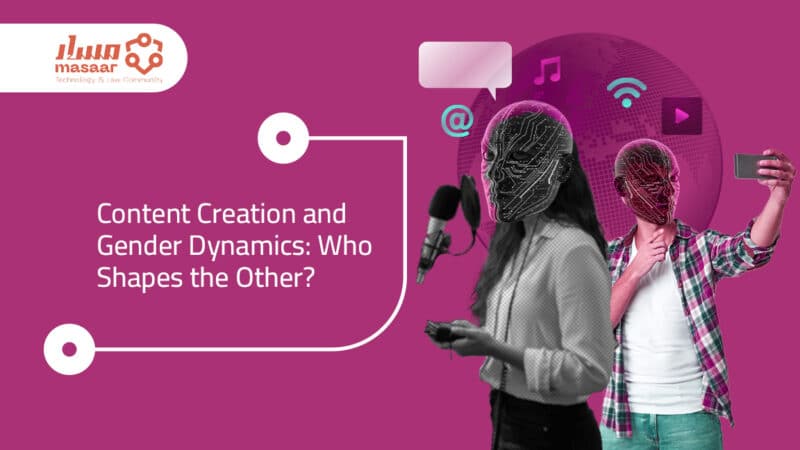
Content Creation and Gender Dynamics: Who Shapes the Other?
Introduction
Among the many phenomena the Internet has produced, content creation stands out as one of the most significant and influential. Although it is now closely associated with social media networks, it cannot be reduced to them; it predates these networks historically, and its early forms helped shape and develop them.
Content creation also continues to flourish across other mediums—such as websites, blogs, podcasts, and newsletters. It can be argued that the close link between content creation and social media networks stems from mutual benefit, not from the complete dependence of either on the other.
In this context, this paper examines online content creation in its broader sense, not merely within the specific confines of social media networks. It explores the relationship between content creation and gender dynamics through three pillars: expanding opportunities for self-expression; opening spaces for social influence; and enabling individuals to generate income via the Internet.
The paper also addresses the governing factors that shape the interaction between content creation and gender dynamics. It discusses the limits and constraints imposed by social, cultural, and economic determinants on this relationship, as well as the possibilities for addressing them.
The paper further seeks to show that the evolution of content-creation practices often proceeds from within the field itself, through initiatives and support communities that form around women content creators and help them face social, cultural, and economic pressures.
Factors Shaping the Interaction between Content Creation and Gender Dynamics
Content creation and gender dynamics interact reciprocally. Gender dynamics refer to the system of relationships, expectations, and social norms that govern how representations of femininity, masculinity, and other gender identities are constructed and managed. They also include the associated patterns of acceptance/punishment and punishment, as well as the distribution of roles and opportunities. These dynamics manifest in everyday life and across digital platforms, shifting according to class, spatial, and cultural context.
Content creation is a form of personal self-expression and a tool through which individuals communicate with others, and there is no doubt that gender is a key factor in both processes. Accordingly, gender dynamics influence the content individuals produce in ways that reflect the nature of those dynamics—whether they are dominant within the society to which they belong or unique to each of them on a personal level.
On the other hand, content-creation practices impose their own frameworks and dynamics, shaping how individuals express gender, whether directly and intentionally or indirectly and spontaneously. A gradual transition can be observed in content-creation processes: an initial phase dominated by leveraging opportunities for spontaneous self-expression; followed by a phase in which societal influence became more prominent (especially among activists engaged in political, cultural, and social issues); and finally, a phase in which considerations of monetization have grown way more salient. This classification does not imply that these trajectories do not intersect in various ways, nor does the dominance of any one in a given phase mean the others disappeared entirely.
Content Creation and Opportunities for Self-Expression
Historically, opportunities for self-expression have been a primary driver for the adoption and development of various means of expression. Content creation via the Internet is no different from other communication media in this regard. Likewise, gender remains a fundamental aspect of every individual’s identity and typically occupies a central position in how people express themselves through any medium.
However, online content creation differs from previous means of individual self-expression by lowering the threshold for access, whether through reduced costs or by eliminating traditional skills and qualifications. This access has enabled an increasing number of diverse social groups to create and publish content online.
More importantly, the Internet inherently offers individuals greater freedom compared to traditional media such as radio, television, print newspapers, literary and academic publishing, and others. This accessibility stems from the Internet’s liberation from the control of traditional institutions that previously monopolized access to content creation tools, on the one hand, and from the audience’s access to this content, on the other.
Nevertheless, this freedom is not always guaranteed. Government censorship, platform moderation policies (including content removal, restriction, and visibility ranking), and forms of social pressure such as harassment, bullying, and stalking can all undermine the possibility of expression and push individuals toward self-censorship.
Notably, the possibilities for content creation using digital technology have opened a broader, freer domain for marginalized groups in human societies, foremost among them women. This openness has been reflected in women’s growing ability to express their gendered identities on their own terms. Gender expression refers to the behaviors, appearances, interests, and forms of presentation that an individual displays and that are socially understood as being associated with gender within a given cultural context.
Women’s expression of their own identities has constituted a revolutionary shift, far more profound than many might imagine. In most historical contexts, men monopolized access to the tools of content creation and dissemination, and accordingly monopolized gender expression as a whole. This monopoly extended to the denial of women’s right to produce their own gender expressions, as men, for long periods, constructed gendered representations of women based on their own perceptions.
While the evolution of communication media in the modern era enabled a small minority of women to reclaim their voices, the control traditional institutions exerted over these media suppressed the potential for these efforts to have a tangible impact.
In most cases, the limited opportunities for women’s struggle to reclaim their voices were restricted to specific segments of society. Women within these groups possessed the material and cultural resources that enabled them to fight for creating their own gender expressions and to bear the high costs of doing so. In contrast, the possibilities of online content creation have opened up opportunities for women from diverse social backgrounds to express themselves, and consequently, their gender.
With the ongoing development of digital technologies, the thresholds for accessing content-creation tools have decreased to the point that women from most segments of society today can participate in content creation and dissemination. This access has also led to women’s self-expression moving beyond the politicized struggle framework in which it had been mainly confined in previous periods.
Consequently, women’s self-expression has increasingly taken on a more spontaneous, authentic character. In fact, this has even impacted women with activist orientations, who have become more liberated from the traditional frameworks of their ideologies and are now able to critique them and expose the patriarchal aspects embedded within them.
However, despite expanded access to content creation tools, this access remains unequal; it is hindered by class-based and geographic digital divides related to the cost of devices and connectivity services, the quality of infrastructure, disparities in digital skills, language barriers, disabilities, and social constraints.
The evolution of online content creation processes has, over time, revealed dimensions that were not accessible through prior traditional communication channels. By their very nature, online content creation processes are more subjective and potentially more intimate or immediate than their traditional media counterparts. This distinction is particularly relevant to gender expressions, as such expressions tend to be more authentic the more personal and intimate the communication is.
With the expanded accessibility of content-creation tools and their widespread use by millions of people worldwide, the great diversity of spontaneous gender expressions has emerged in a way that cannot be ignored. Fundamentally, the diversity of gender expressions in online content challenges the assumed polarity between expressions deemed exclusively associated with men and those considered solely associated with women, with clear, demarcating boundaries between the two.
On another axis, this diversity also challenges the presumed polarity between conservative, traditional gender expressions on one side and progressive ones on the other. Overall, through the opportunities it provides for self-expression, online content creation presents a more complex and vibrant picture of gender expressions that resists previously conventional classifications.
Content Creation and Opportunities for Influence
The opportunities for influence afforded by the Internet as a communication medium have been evident since the earliest days of the web and web browsers. The early pioneers of the Internet were primarily those with the technical skills required to build websites at that time, which resulted in very low representation of women in these initial stages.
The ability to reach an audience without having to go through the “gatekeepers” of traditional publishing attracted numerous activists advocating for various political and social causes, while feminist activists were not long in establishing their presence online. Broadly speaking, online content creation developed a political activist tendency that has consistently remained present throughout the stages of its evolution—from the emergence and proliferation of forums, to blogs, and onward to social media platforms.
It can be said that this orientation reached the height of its presence by the end of the first decade of the current century; mass movements such as the Arab Spring may be seen as a prominent indication of the peak of progressive political activism in many cases, as well as of the influential potential afforded by online content creation.
The foregoing points to opportunities for influence that do not differ, in their purpose, from those previously offered by traditional communication media; the intention here is to influence the recipient through content that conveys specific, deliberately crafted messages. However, the evolution of online content creation processes has opened new pathways for influence that have taken shape in a largely spontaneous manner within the framework of this evolution.
These pathways are connected to opportunities for self-expression and have led to a greater diversity in gender expression. The evolution of online discourse has highlighted the potential and opportunities for influence inherent in spontaneous or deliberate gender expressions, which do not necessarily aim to convey specific messages.
It is difficult to reduce the impact of online content to a single, clear message. For instance, it is often challenging to judge the impact of the gender expressions in a piece of content in terms of whether they are conservative or progressive, or whether they reinforce or challenge gender stereotypes. In most cases, it can be said that content presented online blends these opposites in a complex and ambiguous manner.
Many of the common forms of gender expression used by women and girls in online content are interpreted by some as a form of “self-commodification”, while other readings view them as a reclaiming of bodily autonomy beyond patriarchal control. When these women—especially in conservative societies—face social or institutional punishment, a striking paradox emerges: in some cases, the punishment is justified by claiming that they “misused what they possess”, while in others it is rationalized by alleging that they have “encroached upon what they do not possess”.
Furthermore, the subjective nature of online content creation opens a grey area between the private and the public concerning gender dynamics. Content creators live out a part of their daily lives through the content they produce, including aspects related to their personal relationships. In all cases, there is an impact—difficult to measure—of this vast diversity of personal experiences connected to gender dynamics, which audiences are constantly exposed to. And it is impossible to determine a dominant direction for this impact—whether it is conservative or progressive. What is certain, however, is that online content creation weakens the taken-for-granted polarizations surrounding gender dynamics and instead presents a more complex, and perhaps somewhat chaotic, picture. It can also be said that the practices of content creation and the effects they have on the lives of those who engage in them add further layers of complexity to gender dynamics in their own right.
The opportunities for influence afforded by online content creation largely possess a character that undermines conventional assumptions, whether on the traditional-conservative side or the progressive side. There is a cumulative effect of the widespread and proliferating online content on gender dynamics within different societies; however, this effect is not classifiable according to traditional frameworks. In fact, it poses significant challenges not only for defenders of traditional and reactionary values in society but also for advocates of progressive values.
Content Creation and Monetization Opportunities
The trend of online content creation towards generating income is a natural development within the capitalist framework that dominates today’s societies. Opportunities for monetizing content have accelerated to the point where this field has become a major industry within the Internet economy. It is difficult to ignore that these emerging opportunities for profiting from content have contributed significantly to the enormous growth in the number of people engaged in these processes. The financial return has attracted a vast number of individuals from diverse social backgrounds who primarily seek to improve their standard of living through content creation.
It should first be noted that the gender gap is by no means absent from online content creation. In many sectors, the vast majority of participants are men, and, on average, men still generate higher revenue from content creation activities compared to women.
For any woman, the opportunity to secure a source of income represents a chance for financial independence, and for many women, the requirements to access such an opportunity in the traditional labor market remain unattainable. Lowering the threshold of these requirements opens the door for millions of women worldwide to secure their own source of income, thereby enabling greater financial independence from their families. Women’s attainment of this independence inevitably reshapes many gender dynamics within their families and immediate communities, but it would also impact the traditional perception of these dynamics beyond this sphere.
Limits and Obstacles to Positive Influence
As discussed earlier, online content creation opens pathways for self-expression, influence, and financial gain. Although one cannot definitively claim that the impact of these pathways on gender dynamics is always positive from a progressive standpoint, the mere availability of these pathways represents a positive element per se, as long as they enjoy the greatest possible degree of openness and freedom. However, practical reality does not fully align with this conception; there are numerous obstacles and determinants that restrict this openness and freedom, which in turn affect how these pathways interact with gender dynamics. This section addresses the obstacles and determinants most directly relevant to gender dynamics.
Self-Expression and the Limits of Gender Stereotypes
The prevalence of spontaneity in the gender expressions produced by content creators significantly influences the reactions they receive. In many cases, this very spontaneity can create a margin of tolerance for expressions that do not stray far from, or clearly outside, the framework of stereotypes. Conversely, certain portrayals can unsettle audiences when it is difficult to determine the extent to which they deviate from traditional stereotypes, often eliciting mixed and hesitant responses.
In addition, the spontaneity of gender expressions may, in many cases, lead to their association by recipients with different class and categorical classifications, usually in a negative way, which leads to the female content creators being subjected to bullying and ridicule based on their class affiliations or their classification according to their level of education.
In another manifestation of the intersection between categorical classifications and gender stereotypes, the acceptance or rejection of specific gender expressions varies according to these classifications. In its most extreme form, this disparity can range from accepting certain gender expressions when exhibited by some social groups to punishing members of other groups for the very same expressions. This means that women from marginalized groups (such as those who are poorer, rural, etc.) are vulnerable to compounded discrimination.
Moving beyond individual cases and focusing on the bigger picture, it becomes clear that online content creation has created a battleground around what constitutes acceptable or unacceptable gender expression. This struggle reveals that when it comes to girls and women, many societies find it difficult to accept their freedom of self-expression, particularly when it comes to gender expression. Consequently, many women involved in online content creation choose to avoid this conflict, often by deliberately presenting alternative identities that conform to socially accepted gender stereotypes.
The increasing restrictions on opportunities for self-expression, particularly for women, through content creation, are the flip side of the expanding reach of this content. As their audience grows, so does the pressure on them, making them more vulnerable to societal and institutional punishment. This means that, in many cases, the likely price for success and for avoiding the dangers of such punishment is to relinquish a degree of spontaneity and freedom of expression, and instead conform to stereotypical gender portrayals.
Opportunities for Influence and Limits of Responding to Prevailing Cultural Expectations
The expectations imposed by the dominant culture in any society operate at a deeper level than common stereotypes. These expectations relate to the image individuals are expected to present to society, and many gender dynamics are linked to this image; this includes, in particular, the nature of gender roles within the family. Individuals are raised in a way that prepares them to conform to the expected image, regardless of its authenticity. As a result, the pressure to conform to this expected image originates within individuals themselves before it is imposed by others.
When women content creators present aspects of their personal lives within their content, some feel compelled to ensure that these aspects reflect the idealized image expected within their cultural context. This places them under significant pressure, particularly when the gap widens between the actual gender dynamics in their lives and the idealized image they are expected to project. In certain cases, these pressures may develop into latent crises that threaten their mental well-being, especially when personal events force a revelation of the fragility of the image they have grown accustomed to presenting.
Such crises are not uncommon, and they contribute to the complex and contradictory nature of content creation’s impact on gender dynamics in society. On the other hand, many recipients of online content tend to believe the idealized images presented by women content creators about the nature of gender dynamics in their lives; thus, much of this content reinforces prevailing cultural expectations despite their falsity, and perhaps despite the difficulty—or at times the impossibility—of fulfilling them.
The danger of this effect lies in the fact that prevailing cultural expectations are fundamentally based on discrimination against women, confining them to gender roles that restrict their freedom and hinder the achievement of gender equality. Presenting these expectations as idealized, false images reinforces their persistence and discourages some women from challenging the discrimination they face; they tend to believe that the inequitable gender dynamics they experience are due either to bad luck or personal shortcomings.
Financial Gain and Requirements of Profit-Oriented Entities
Most of the financial opportunities offered by content creation today stem from mechanisms established and controlled by major technology companies that operate the websites and platforms through which content is published, primarily social media platforms. These mechanisms are designed to maximize profitability, which in practice means transforming content into a commodity subject to the laws of supply and demand.
Amid prevailing gender biases and expectations, demand for certain types of content that women can produce is largely confined to a narrow space, while many other forms of content are treated as if reserved for men, based on perceptions and biases that consider women unqualified to produce them.
In this context, many women content creators find themselves compelled to produce the content expected of them rather than what they wish to create, regardless of their qualifications or skills. In many cases, the demands of supply and demand push content creators into a space where their own identities and personal lives become the commodity they promote, whether or not this aligns with their free choice.
This situation intersects with the pressures and obstacles previously discussed in the contexts of self-expression and influence. The commodification of gender expressions and dynamics imposes additional pressures on female creators, pushing them to present artificial expressions or false idealized portrayals of the gender dynamics in their lives, based on anticipated demand. Consequently, whether these expressions align with prevailing stereotypes or challenge them, they are often less spontaneous or authentic than they are tailored to satisfy specific target audience segments.
The commodification of gender expressions and dynamics in digital content can lead to troubling consequences for gender equality, particularly when market logic favors stereotypical, marketable images and weakens alternative forms of expression. In certain contexts, this trend may undermine hard-won gains by perpetuating representations that reduce women’s identities to objects of consumption.
Efforts to Maximize Positive Impacts and Ways to Support Them
Creating online content is, at its core, a process that evolves and is shaped by an infinite number of factors that change over time; this means that opportunities to influence the course of this process from the outside remain limited. Therefore, this section offers some recommendations to specific entities regarding the implementation of policies or the provision of support to address the obstacles discussed in the previous section.
In contrast, this section explores the ways in which women involved in content creation, mostly spontaneously, cope with the pressures they face, which hinder their ability to benefit from the opportunities that content creation offers for self-expression, influence, and financial gain.
Challenging Gender Stereotypes
While many women involved in content creation prefer to avoid engaging in the struggle over their spontaneous gender expressions, others do engage in this struggle—sometimes unintentionally—due to the very nature of the interactions themselves. In other words, this state of conflict generates a form of struggle that is neither politically motivated nor deliberately intended to confront it.
The most evident aspect of this situation is the confrontation with gender stereotypes, particularly associated with various social categories. Many women content creators face bullying based on class, regional, or other distinctions, and they often rely on the support of a segment of their followers. In many cases, revealing the class-based, regional, or other biased nature of the bullying generates sufficient supportive responses to counter it.
In other cases, women content creators recognize the inherent contradiction in negative reactions to their gender expressions. More often than not, it is precisely these expressions—those that diverge from prevailing, stereotypical, or expected norms—that contribute to the growth of their follower base, even amid increasing negative responses. Revealing this self-contradictory nature of societal responses to women’s gender expressions gives many content creators greater confidence that the best approach is to express themselves freely and choose what satisfies them, rather than attempting to please others.
On another front, content creators cannot confront the threat of institutional sanction using the same mechanisms. It is the duty of institutions, whether public or private (including state institutions and judicial authorities), to respect and protect the right to freedom of expression and to refrain from interfering in the choices of those under their authority related to self-expression. Any potential intervention is only legitimate if it is based on a clear and publicly available law, meets the tests of necessity, suitability, and proportionality to protect legitimate aims (such as the rights of others), and provides effective avenues for appeal. Any other form of intervention constitutes arbitrary interference and a violation of freedom of expression, in addition to being unconstitutional.
Creating Countervailing Subcultures
The Internet, as a medium of human communication, possesses a remarkable ability to reshape individuals’ attitudes, opinions, and ideas. It is also an effective means for forming small communities that transcend the traditional boundaries separating people. Online content creation remains one of the primary tools for communication and for bringing together like-minded individuals, often regardless of their geographical or social-class positions.
Thus, while individuals, especially women, may face pressure from their immediate communities when they express gender views that contradict prevailing stereotypes or when they speak out about discriminatory gender dynamics, they can also find support. This support may be limited to a minority, but it helps them cope with the pressures they face. Over time, small groups that challenge traditional norms in different societies can connect and grow, aided by the Internet’s ability to transcend traditional boundaries.
Online content creation supports the emergence and development of such virtual communities, as well as their adoption of cultural values that differ from those dominant in traditional societies. While it cannot be expected that these small communities will transform from a minority into a majority in the near future, they remain capable of exerting influence and, importantly, of fostering solidarity and mutual support among their members.
Such small, virtual communities can free many women content creators from the need to present a false image of their experiences with discriminatory gender dynamics. In practice, content creators who refuse to present idealized or false images often come together to form a nucleus around which these supportive small communities can be built.
Creating Free Collaborative Alternatives for Monetization
There are already numerous alternatives for generating financial gain through online content creation beyond the mechanisms provided by content publishing sites and social media platforms. For example, there are services that allow content consumers to support creators directly, either through one-time donations or recurring subscriptions to ensure the continued production of new content.
While these services remain largely commercial, they offer a more neutral alternative to the laws of supply and demand. They allow content creators to choose to conform to these laws or rely on support from audiences that may be limited but specifically aligned with the type of content they wish to produce. There will always be individuals who value quality content without preconceived gender biases that might otherwise dictate their perceptions of what a content creator can offer based on their gender.
Having alternatives to the commodification mechanisms offered by content publishing platforms is crucial for women content creators, who often find it difficult to monetize their work by creating content that reflects their identities and choices.
These alternatives depend on building support groups. Within such groups, content can be de-commodified and viewed as a valuable asset produced by individuals for the benefit of their community, with the community rewarding them according to the effort invested in its creation. Groups of individuals who appreciate the value of content that offers diverse and unconventional gender expressions and adds authentic personal experiences can support the continued production of this content by collaborating to provide appropriate financial support.
In practice, such alternatives can take the form of content publishing platforms where creators are supported through direct subscriptions from their audiences. This model is already implemented commercially, but nothing prevents it from being organized cooperatively or relying on periodic support from civil society organizations. Beyond providing the support that women content creators often lack within traditional commercial frameworks, there is also a broader incentive: to counter the threats posed by the dominance of commodified gender expressions and dynamics, as previously discussed.
Conclusion
The online content creation industry today may represent one of the most widespread and socially impactful forms of human activity. While this industry reflects the prevailing social dynamics within human societies, it also plays a significant role in rapidly reshaping those dynamics.
Within this framework, social change efforts—particularly those aimed at achieving gender equality—should accord content creation the attention it deserves as a potential tool for preparing societies to advance toward their goals. Understanding the relationship between online content creation processes and gender dynamics in society is a necessary step that should precede any attempts to leverage it as a tool to achieve gender equality.